Knowing when it’s time to go is wisdom. — Terry Pratchett
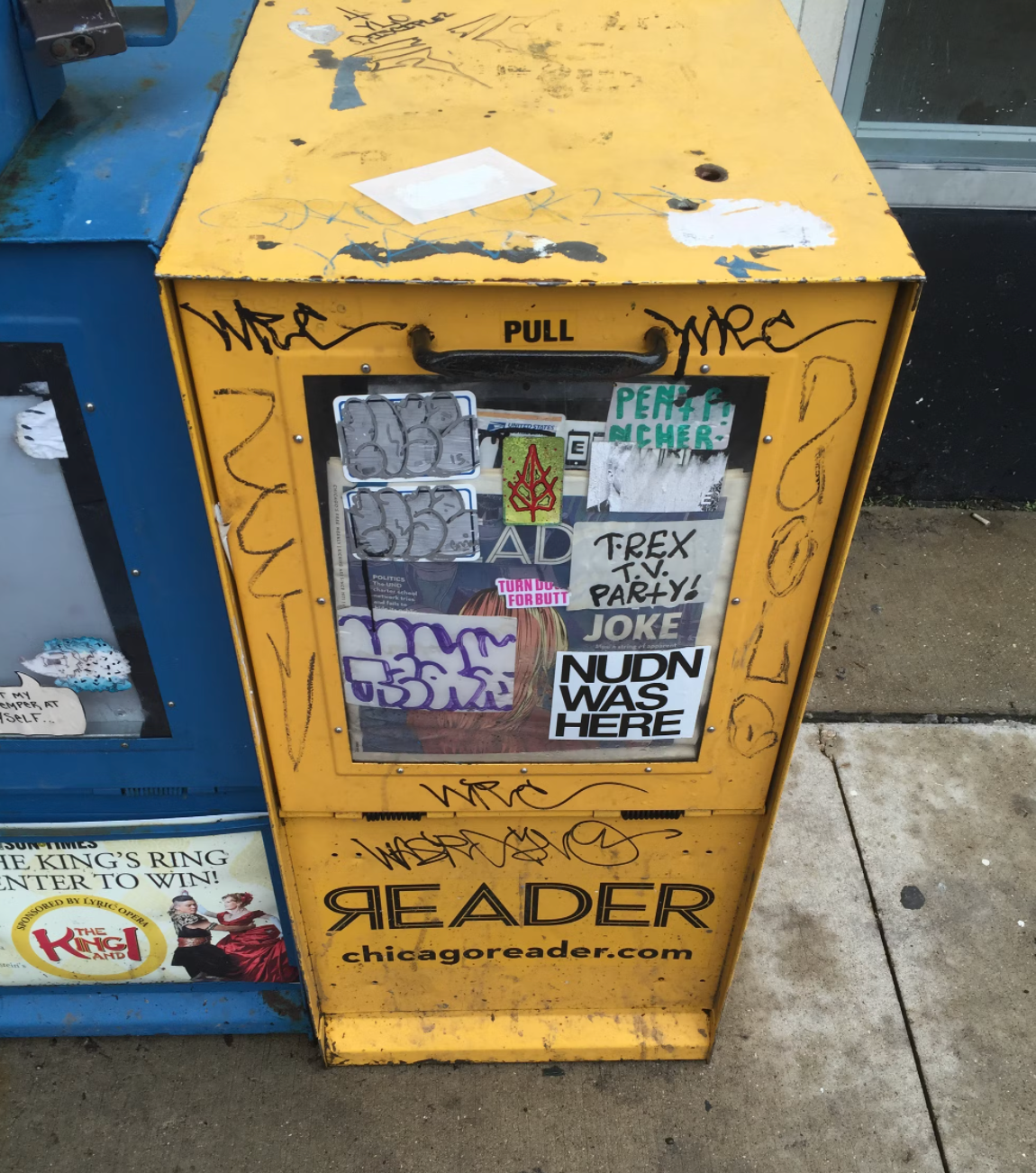
I take no pleasure in saying this. I’m not rooting for failure, and I’m not blind to its history. For decades the Chicago Reader mattered. For decades, it mattered a lot. It broke stories that no one else would touch, treated arts and culture as something more than a false AI narrative (see that Chicago Sun-Times summer reading list), and gave Chicagoans a weekly sense of now. What was happening. What was emerging. What was worth paying attention to and arguing about.
My Evanston college friends and I couldn’t wait to grab a copy at the Record Exchange on Dempster near the el. Starting with the always fascinating personals, and then we devoured the paper like a perfectly cooked bowl of Kraft Macaroni and Cheese.
But that Reader is long gone, and what’s happening now is not a rebirth. It’s a form of prolonged, awkward hospice care.
The latest plan, converting the Reader into a monthly publication under new ownership, propped up by a hybrid for-profit/nonprofit model while begging for philanthropic support, is being sold as yet another reinvention. It’s not. It’s managed decline with noisier branding.
Isn’t an alternative weekly that publishes monthly a contradiction in terms? An “oxymoron” if you wish?
The Reader’s power came from its incredible rhythm and immediacy. You picked it up because it was current and it told you what was happening this week in this city. The Tribune and the Sun-Times couldn’t keep up. I wanted to know where The Price of Priesthood was performing next Saturday. But once that cadence is gone, so is any reason to exist.
A monthly Reader isn’t alternative. It’s archival. And the market knows it.
When I’ve invoked some mild humor with, “They literally can’t give that paper away,” it isn’t snark. It’s the sad truth. Free distribution only works when readers want to pick up your paper. But when stacks of your publication sit untouched in cafés and bookstores, it isn’t a marketing failure or a branding problem. It’s an audience verdict.
No amount of restocking or reimagining the revenue mix changes the core truth: the Reader is no longer culturally necessary.
The new owners talk about innovation, diversification, and “special sauce.” But what they’re really building is a philanthropic media platform in disguise — journalism funded by donors, foundations, and auxiliary businesses like ticketing and events. That model might be able to produce some solid investigative work, but it cannot recreate what an alternative weekly was.
Even when the Reader had the resources, the staff, and the cultural oxygen to do that kind of work consistently, they chose not to. Instead of their traditional broad, city-spanning reporting that reflected how most Chicagoans actually lived, the paper narrowed its lens to a small set of ideological obsessions, with coverage increasingly dominated by identity-centric topics already well served elsewhere. That editorial tunnel vision didn’t expand the Reader’s relevance or audience; it shrank it. In a city of millions, a publication that once prided itself on curiosity and range opted for repetition and moral signaling, confusing intensity of focus with importance, and in the process, alienated far more readers than it ever mobilized.
The Reader wasn’t beloved because it was sustainable. It was beloved because it was urgent, weird, inconvenient, and plugged directly into the city’s magnificent nervous system undercurrent. You didn’t read it because it had a clever business model. You read it because it felt alive and different.
It mattered.
But what’s being proposed now is something else entirely: a legacy brand preserved for sentimental reasons, retooled to satisfy grant cycles and balance sheets. That’s not revival. That’s curation.
There’s nothing inherently wrong with letting an institution die a peaceful death. (Take note SNL.) Cultures change. Media forms evolve. The insult isn’t acknowledging that reality. The insult is pretending that there’s continuity where none exists. And your former readers already know it. Asking them to treat a monthly, donor-backed publication as the same thing that once defined alternative journalism in Chicago is pure folly when it clearly isn’t.
There comes a time when survival stops being a virtue.
The Chicago Reader had a remarkable run. It trained writers and critics, it shaped debates, and it told stories that would otherwise have been lost. That legacy doesn’t disappear if the paper closes, but it will be greatly diminished and cheapened by dragging the name forward long after the conditions that made it meaningful have gone the way of the PDA.
Letting it die isn’t an act of hostility. It’s an act of honesty.
Chicago doesn’t need a zombie version of the Reader, endlessly rebooted and rebranded as the “newsroom” shrinks to quantum level proportions. It needs new forms, new voices, new experiments that reflect how people actually live and consume information NOW— not a museum piece disguised as reinvention.
There is great dignity in a mindful ending. There is none in pretending that a terrifying decline is rebirth.
Please don’t become what you once loathed. The Reader mattered. Past tense.
That should be enough.


