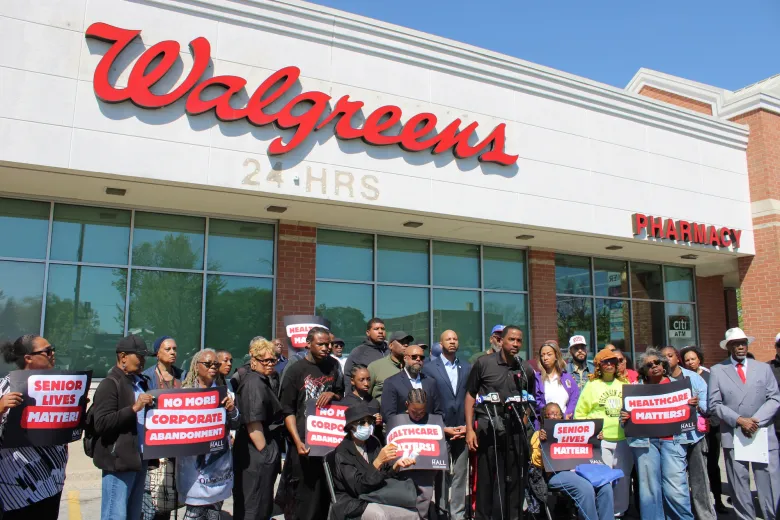
Let me start with a confession that will officially disqualify me from all the outrage. I don’t shop at Walgreens. Not in Chatham. Not anywhere.
That’s not a moral stand. It’s self-preservation. At some point, Walgreens made the decision that customers clearly enjoy being treated like suspects in a low-budget heist movie, so let’s give ‘em what they want. Locked cases. Skeleton crews. Lines that don’t move, and that unmistakable feeling that showing up with money was your first mistake.
Walgreens is the only retail chain that’s managed to combine the charm of the DMV with the security protocols of Fort Knox, without the efficiency of either. So I left. Happily. That means I have no dog in the fight over the Chatham store closing—except for one minor detail.
An ADHD-addled sixth grader coming off a three-day sugar-and-video-gaming binge could’ve seen this coming a mile away. Now that the store is closing, the political fallout was equally predictable.
Let’s start with a concept that shouldn’t require explanation, but apparently does. A business has no obligation to remain open while hemorrhaging money. That’s not greed. That’s math. A business has no obligation to remain open while being robbed blind. Not inconvenienced. Not “experiencing shrink.” Robbed repeatedly and casually by people from the community who don’t think twice about loading up a bag like they’re packing for a weekend trip because the odds of serious consequences sit somewhere between slim and theoretical.
Then we expect employees, making just enough to show up again tomorrow, to intervene? No one working a retail shift should have to confront a masked idiot emptying shelves into a pillowcase. That’s not loss prevention. That’s a workplace safety issue masquerading as a policy choice.
So Walgreens does what any rational business would do. It leaves. And right on cue, the same aldercreatures who wouldn’t put a dime of their own money into that situation step forward to blame the store. Because if there’s one thing Chicago has mastered, it’s punishing the last entity willing to give it a shot.
It’s the same tired script, too. Walgreens has failed the community. Walgreens should have worked harder. Walgreens should have stayed and absorbed the losses for the greater good, where the “greater good” is a balance sheet that only works if reality is politely ignored.
Meanwhile, Brandon Johnson continues to project the calm confidence of a man who believes that if he avoids acknowledging a “trend” long enough, it will resolve itself out of courtesy. Not to mention the City Council’s response has been nothing if not ambitious.
Fourth Ward Alderman Lamont Robinson is reportedly drafting a “big box ordinance” to prevent companies like Walgreens, Walmart, and Target from “abandoning” communities. That’s right! If businesses are leaving because conditions make it impossible to stay, the solution is to make closing more difficult. One imagines the next step is requiring them to smile and say, “Thank you, sir, may I have another?” while held up at gunpoint.

Chatham Alderman William Hall described the closure as “pharmaceutical genocide,” a phrase so wildly disproportionate it almost deserves a moment of stunned silence. When a company decides it can no longer operate safely or profitably, the problem isn’t theft, policy, or economics. It’s a moral atrocity.
But this is where the script stops being predictable and starts being instructive.
Because every time a commercial entity closes under these conditions and is roundly pilloried for doing so, the message to every other potential business is clear. Stay away. Don’t open. Don’t expand. Don’t invest. Because if things go bad, you won’t be supported. Oh no! You’ll get a press conference where you become the moral equivalent of the Holocaust.
And that matters more than any speech, because the next store, the next pharmacy, the next grocery chain are all watching and making the same Second City calculation. Is it safe? Is it possible to make money? And if the answer to either question is “no,” will we at least be allowed to leave without being publicly flogged?
Right now, the answer is no on all three counts.
Yes, the closure is unfortunate. People losing access to prescriptions and basic goods is not trivial. But pretending that shaming or regulating a business into staying open is a solution isn’t one. It’s just more high school theatrics.
If you really want businesses to stay, the formula is simple. Make it possible for them to do business without constant theft. Make it possible for employees to do their jobs without risking their lives. Acknowledge that profit isn’t a character flaw. It’s the reason the store exists.
Without that, this doesn’t end with the Chatham Walgreens. It will repeat. Another store, another closure, another round of outrage, and another set of speeches that carefully avoid the root cause. And somewhere, in a corporate office far away, someone looking at a map of Chicago quietly moves a pin from “maybe” to “no.”
And when that happens, it will no doubt come as a complete surprise.
Again.