I graduated from Loyola University of Chicago in 1985, and I lived in East Rogers Park for eight years. Not visited. Not commuted. I lived there. I walked the campus and ran those streets and beaches. I learned which blocks were reasonable, which ones weren’t, and more importantly, how quickly one could turn into the other without warning.
That’s the part nobody tells you.
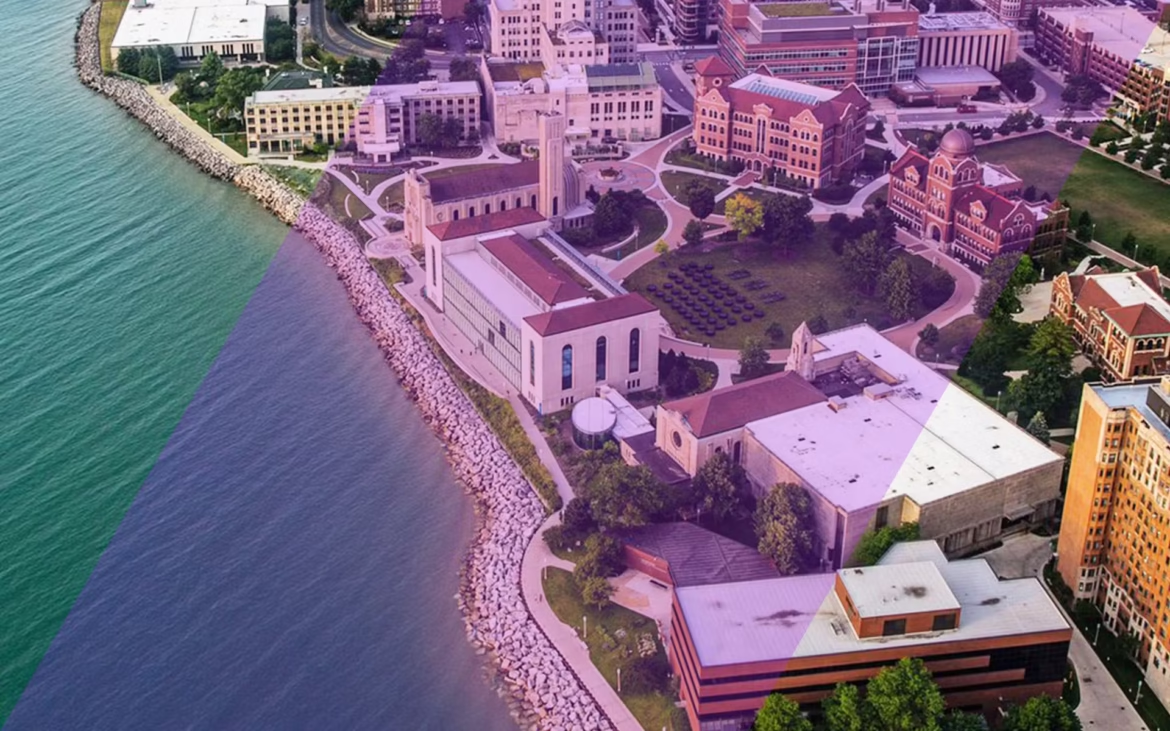
Because if you listen to Loyola, read their materials, or take a campus tour—much like the Jesuits who ostensibly run the institution —you’d think the university exists in a kind of lakeside bubble. Safe. Insulated. Self-contained.
It doesn’t.
This week made that painfully clear.
An 18-year-old Loyola freshman was shot and killed near campus while walking with friends along the lakefront early Thursday morning. She was not the target. She was simply there.
That’s the reality.
And everything that follows needs to be understood in that context, not softened, not explained away, and not buried beneath the flowery language institutions inevitably reach for whenever a tragedy like this happens. “Thoughts and prayers” are the coward’s excuse for doing absolutely nothing.
There’s never been the kind of hostility between Loyola and Rogers Park that exists between Northwestern and Evanston. It’s not adversarial. It’s different. They largely ignore each other, as if each exists in a separate reality that just happens to occupy the same time and space.
That arrangement works… until it doesn’t.
Rogers Park is not a war zone, and anyone who says otherwise doesn’t know what they’re talking about. Violent crime like this is rare. But what is absolutely true—and what anyone who has actually lived there understands—is that the neighborhood changes block by block, corner by corner, and those changes aren’t always obvious until you’re already standing squarely in the middle of them.
You can walk past stately homes and gated buildings and, in less than a minute, find yourself somewhere quite different. Not a little worse. Quite different. That’s not fearmongering. That’s the truth.
It’s a reality that Loyola does very little to communicate in any meaningful way.
Students are allowed to believe that the campus experience extends outward indefinitely, and that the sense of safety they feel on university property somehow follows them wherever they go.
But it doesn’t.
I’ve seen people say, “Well, this could happen anywhere,” which is technically true and therefore meaningless. Risk is not evenly distributed, and anyone who’s spent any real time in Rogers Park knows that time and place matter.
This is why, when I lived there, I would not have been casually walking off campus at 2 a.m., or 10 p.m. for that matter. That’s not judgment. That’s awareness. There are places and times where the bad spills over into the good and the margin for error becomes razor thin. Most Loyola students don’t begin to recognize that reality.
Then, when something goes wrong, you wind up relying on a police presence that, in Rogers Park, has never inspired confidence. That’s not a political talking point. That’s lived experience. The local precincts were widely regarded as ineffective when I was there, and nothing suggests that reputation has improved. If anything it’s gotten worse. Response, follow-through, and visibility all matter, and they fall short in that neighborhood.
Frighteningly short.
I’ll be very surprised if the CPD’s “investigation” leads to an arrest.
That broader reality doesn’t exist in a vacuum, either. Chicago loves to argue about crime. They can’t wait to debate it, study it, contextualize it, make glorious proclamations, and then explain it away. Meanwhile, the basic expectation—the one where the city consistently projects order and enforces the law—becomes an afterthought. Call it nuance if you like, but from the outside, and often from the inside, it looks a lot more like City Hall fiddling while Chicago burns.
But what’s most telling in the aftermath isn’t just the crime itself. It’s the University’s “response.”
Students replying to the university president’s useless social media message said no email or text warnings were ever issued. They had to learn about this senseless murder through social media and the news.
That fits the Loyola I knew perfectly, because Loyola doesn’t care about anyone but Loyola.
Not in the cartoon villain sense, but in the institutional sense. They care about their reputation, their image, and the version of reality they choose to promote, and anything that disrupts that is minimized, delayed, or reframed.
That deficit creates a gap between what students and parents think this environment is and what it really is.
That gap matters.
It matters because students make decisions based on incomplete information, and parents send their kids off believing they understand Rogers Park when they don’t. How could they? Closing that gap would require Loyola to say some uncomfortable things out loud, and they have no interest or intention of doing so.
So I will.
If you’re considering sending your child to Loyola University, understand exactly where you’re sending them. Understand that the campus is not a protective bubble that extends beyond its borders, and that the surrounding neighborhood is complex, inconsistent, and changes much faster than you think.
I lived there.
I know exactly what it is.
I wouldn’t send my children to Loyola University.